
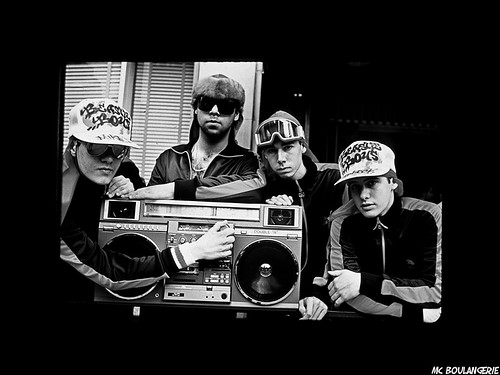
Just a couple quick before bed comments on this weekend’s novella on Rick Rubin swooping in to save Columbia in last weekend’s NYT Mag:
First of all, I am a certified Rick Rubin fan and despite the fact that I met Jay-Z at his house and we were introduced (again) at a 3 year-old’s birthday party in Malibu a few weekends ago I have never had a single conversation with the guy. But from Public Enemy to Slayer to Cash and Neil Diamond to witnessing him totally geek out like a fan boy at a Radiohead show at the 9:30 club ten years ago, I have nothing but respect for his ears.
Where the article is right on is pointing out that a record label’s first job is making great music. As Umair pointed out and I mentioned in my presentation at BarCamp a year and a half ago, quality is hyper-efficient in the Media 2.0 world and content companies need to invest in quality content above all else. As Alan says: record labels used to know how to look at a tree and see the table; modern record labels core competency is marketing and selling a finished table at Wal-Mart. Getting someone in there who can actually take something good and make it great is a Good Move (TM). One person isn’t enough, of course, so I hope Rick brings some friends. Rumor has it Matt Sweeny has been helping him out as of late, which bodes well.
But how weird was the “subscription is the answer” part of the article, with no reference to the fact that Rhapsody, Napster, Emusic, and Yahoo! have been spending millions of dollars marketing music subscriptions for years? You and I could all talk at length about what the issues have been (DRM, consumer confusion, Apple, etc), but the article introduces it as if it’s a new idea. “Subscription Music! Imagine this magical world!” Huh?
Also funny is the lack of mention of how consistently mediocre American Recordings was as a label. Apart from the Milk EP (“Never Dated”) and the Cash records I can’t even name a record I loved from that label. Despite being the hugest Misfits/Samhain fan on the planet (or probably because of) I thought the Danzig records were weak and no, I never liked The Black Crowes (sorry, Sam Velde). Did I miss some A&R genius there? The Jayhawks, I’ll give ’em The Jayhawks. And that one John Doe record. But the world didn’t stop when American closed. No one wept. No one noticed, as far as I remember.
But most importantly, the article does point out that the machinery of the majors is built to dominate radio, MTV, and retail, an entire infrastructure that doesn’t amount to anything but cost in the Media 2.0 world. The challenge for Rick is, where does size actually help? It’s going to be much easier to have success on a smaller scale, which is what Rick does best. The perfect Media 2.0 play for Rick (IMHO) would be to do exactly what he does — identify great talent and do whatever is appropriate for them and their fans, noting specifically that this might not be a 70 minute album anymore. Why not release songs in a bloggy sort of way, outlining the recording/writing process, show us the story that went with the album, make it last a year, sell the tracks on iTunes, give a couple away, give us some video, sell us a t-shirt, take us to a live show, and at the end package it up in a DVD box set that we want to spend $30 on (I just paid $50 for the Magnolia Electric Co box set so it’s not out of the question). Rick could do some amazing art this way.
Question is, can he really scale it across all of Columbia? Can he make the size and reach work for him or is it all just unnecessary overhead/headache? Or will he just spend their money making a few cool projects while the traditional side of the business continues its decline? It’ll be fun to watch.
My advice is that they get some proper social media geeks in there alongside the music geeks. I don’t necessarily mean engineers, I mean people who get blogging, people who understand that you don’t need to work at a company anymore to make a living publishing online (I’m talking about people like Andy, and Andy you know I’m talking about you). It’s why RCRD LBL makes sense — Peter Rojas understands the physics of Web publishing. He lived through the change in cost structure and value proposition between print and online, and this actually does make him extremely well-suited to build a music company on the same model. If you had more of these folks at a label they would be able to help build the label that operates on the “patient for growth, impatient for profit” (Christensen, from The Innovator’s Dilemma) mantra of emergent, scalable businesses.
It’s definitely a very exciting time and I think giving the company to someone with REAL EARS is a huge step forward, since I fundamentally believe that quality is hyper-efficient on the Internet. Now you need someone who gets the whole package, who can conceive of what the PRODUCT looks like in the Media 2.0 world, because it isn’t vinyl at 55 minutes or plastic disks at 72 minutes. But all in all I’m encouraged — it feels like we’re finally getting somewhere this year. The denial is over and some bets are being placed.
ian
postscript: TechDirt was less kind, and right on with the original EFF plan reminder. Lesson is, listen to the market. Swimming up stream isn’t possible on the Internet. Go with the current. Seriously.